 Bakbakum
One hour of speech therapy a week.And 167 hours without.
Bakbakum fills those hours with structured exercises from the speech therapist's plan — and every one of them flows back into the patient profile. At the next session it takes 20 minutes to see where the child stands, and the next plan is set.

Bakum — one of two characters that carry the plan to the child.
- In development with speech-therapy practices in Berlin and Brandenburg
- The care plan stays entirely with the practice
- Servers in Frankfurt — audio stays on the device
Two problems, one week
The family is alone. The practice has no time.
There are 167 hours between two appointments.
One hour of therapy a week. Then the child goes home — and the family practises on alone, for 167 hours. Meanwhile the next child is waiting, because posts stay unfilled. Both problems land on the same week.
Problem 1 · The family
167 hours
alone with the practice, every week
↓ alone in these hours
Problem 2 · The practice
37.2 weeks
waiting list · 1.6 posts unfilled per practice
↑
Bakbakum
documents every exercise — for the speech therapist
One week, hour by hour. Speech therapy for children is prescribed as a 30-, 45- or 60-minute unit, one to three times a week, up to ten units per prescription.
Behind both
And the insurer pays €14.67 bn without knowing whether it works.
Heilmittel spend 2025, up 10.4%. Evaluated on billing data — volumes, not outcomes. Parents say they practise 79% of the time; only half of practices believe it. Nobody has ever measured it.
What Bakbakum does not claim.
That more practice works better is not established (20 randomised trials, no relationship). Nor that an app improves therapy (largest randomised trial: no difference).
Bakbakum does not measure success. Bakbakum makes the 167 hours visible — for the speech therapist, who alone rules on them.
Sources
- 14,67 Mrd. € · +10,4 % — GKV-Spitzenverband, Kennzahlen der gesetzlichen Krankenversicherung, Q4/2025 (vorläufig); Bundesministerium für Gesundheit, Finanzentwicklung der GKV 2025
- § 302 SGB V · Abrechnungsdaten — Gemeinsamer Bundesausschuss, Evaluationsbericht Heilmittelkatalog, 18.03.2026
- „Black Box“ — AOK-Bundesverband / WIdO, Heilmittel-Report 2026, 09.06.2026
- 132 Tage — Bundesagentur für Arbeit, 2024, zitiert nach Deutsches Ärzteblatt, 19.06.2026
- 37,2 Wochen (Nachmittagstermin) · 1,6 unbesetzte Stellen je Praxis — Leder, Versorgungsstrategien in der ambulanten Logopädie, dbl, 2025
- 30/45/60 Min · 1–3×/Woche · bis zu 10 Einheiten — G-BA, Heilmittel-Richtlinie und Heilmittelkatalog, Diagnosegruppe SP1
- 59 % · 26 % · 79 % · 93 % · ein Drittel — Doherty, Quigley, Sheridan & Lynch, Advances in Communication and Swallowing, 2025 — Befragung von 50 Eltern und 67 Therapeut:innen
- keine Dosis-Wirkungs-Beziehung — Zeng, Law & Lindsay, International Journal of Speech-Language Pathology, 2012 — Sekundäranalyse von 20 randomisierten Studien
- computergestütztes Üben ohne Unterschied — McLeod et al., Journal of Speech, Language, and Hearing Research, 2017 — cluster-randomisierte Studie, n = 123, d = 0,08
Full control
The plan is yours. Entirely.
From the sound to the target word.
You set the clinical parameters. Bakbakum turns them into the exercises for home and documents what actually happened. Nothing more — and that is the point.
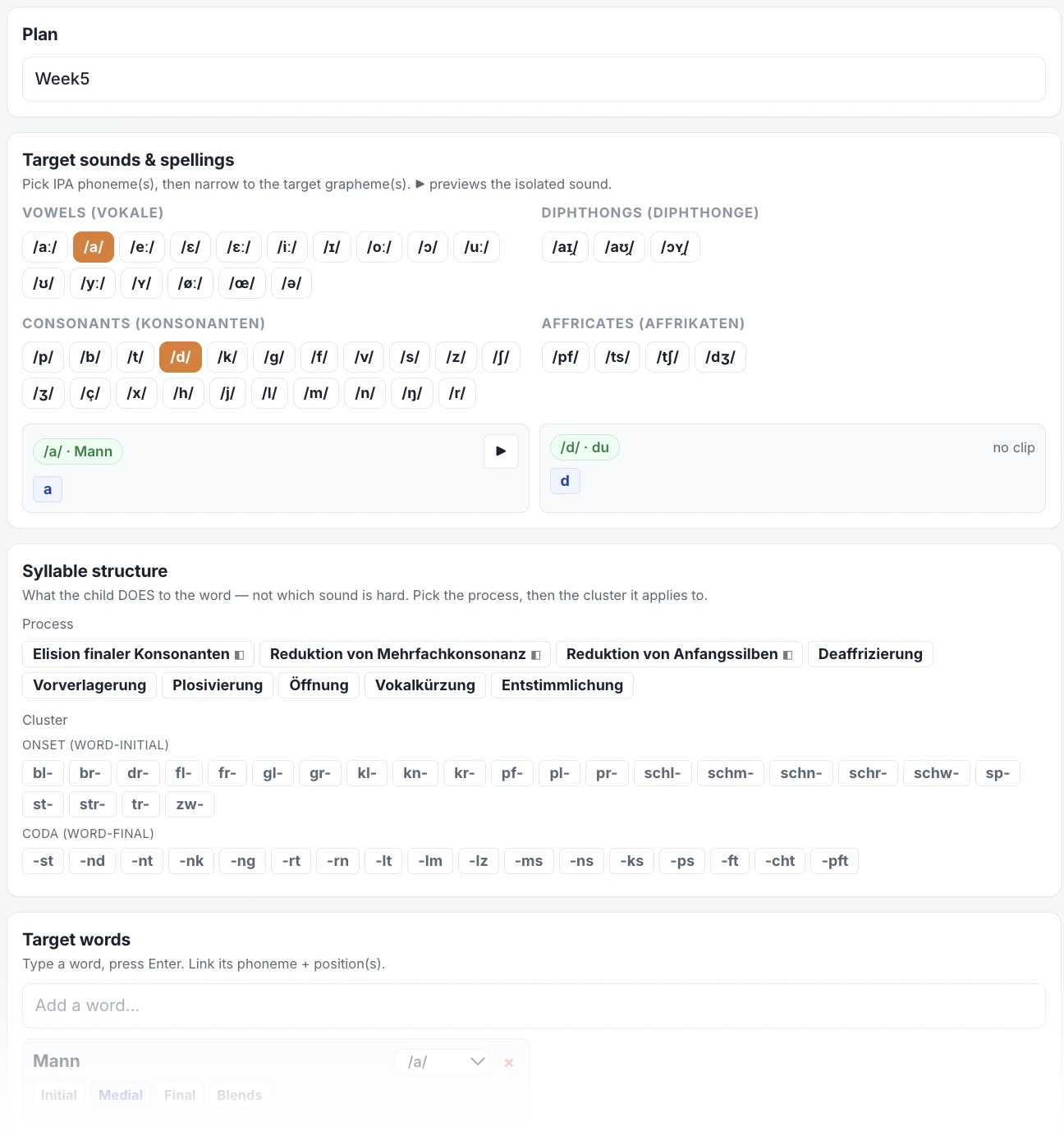
The care plan editor
A plan, in four clicks.
Exactly the fields a practice sets — sound, position, approach.
Target sound
Position in the word
Therapy approach
Target words from this plan
Instruction to the character
Say the word slowly and let the child produce only the target sound /ʃ/ first.
The word plan engine
And what happens when the child answers.
Three routes, all three written by the speech therapist. Try them — the child experiences them as conversation.
The child says
Schuh
Three routes, all three written by the speech therapist. Try them — the child experiences them as conversation.
Written by the speech therapist — not invented by the system.
What you set
Sound
/s/ · /ʃ/ · /k/ · /r/ …
Position in the word
initial · medial · final · blends
Syllable structure
process + cluster — what the child does to the word
Therapy approach
articulation · phonological · language · fluency
Target words
yours, not ours
Note to the family
“Please practise only /s/ this week.”
Every exercise is tied to published evidence.
What Bakbakum does not do
- no diagnosis
- no recommendation
- no judgement of your work
- no decision about the therapy
01
You decide
In the time a session note takes.
02
We deliver
Your plan becomes the exercise on the family's tablet.
03
You see what happened
167 hours of practice, in a single view.
Bakbakum suggests nothing. Bakbakum carries out what you decided.
No recommendation, no score, no model with an opinion. The clinical judgement stays yours.
At home
And the child joins in.
In week three too.
A practice plan is worth nothing if the child will not touch it after four days. Bakbakum is therefore not an exercise app with a character on top. The speech therapist writes the plan — the character is the reason the child opens it again.
Sonne
Target sound /z/ · S
Exercise 3 of 8
Illustration — how Bakum runs one exercise. The word, the target sound and the instruction all come from the speech therapist's plan; Bakbakum invents none of it. No sound plays in your browser.
What the child never sees
- A percentageA friend who is pleased for them
- The word “wrong”“Almost! Again?”
- A game without an endAn ending the speech therapist sets in the plan
A genuine attempt wrongly rejected costs a child confidence. A near miss generously accepted costs almost nothing. In case of doubt Bakbakum decides in the child's favour — and puts every borderline attempt in front of the speech therapist, who alone rules on it.
Screen time — set by the speech therapist in the plan
The 167 hours do not happen because the family is disciplined.
They happen because the child wants to go there.
What gets practised in those hours is the speech therapist's call.
Bakbakum AI
An AI that admits
when it isn't sure.
That is rarer than it should be.
Almost every speech recogniser is trained to be robust to the very deviation therapy needs to measure — it smooths the child's production towards the nearest dictionary entry. What then lands in the record is a language model's guess, not what the child actually said.
One run
- 1The plan
- 2The decision
- 3The record
In the practice
You set the plan
Target sound, exercises, duration — your call.
- Schuh10×
- Schule10×
- waschen8×
10 minutes · dailysent to the child
At home
The child practises
Ten minutes a day, with Bakum, without you.

Next session
You see what happened
In the profile, before the child walks in.
33 exercises this week+2 new from practice
Alignment, step by step
Illustration with fixed example data — not live scoring in your browser.
- Target word from the plan
- Schuh
- Child says
- …
Aligning …
- Schuhtargettarget
- Suh/ʃ/ → /s//ʃ/ → /s/
- Tuh/ʃ/ → /t//ʃ/ → /t/
Result
…
What comes back
Not a number. A record.
The child practises alone at home — but you do not get “82 % correct” back. You get the level you already work at: sound, position, word, attempt.
/ʃ/
Initial
Medial
Final
Blends
/s/
Initial
Medial
Final
Blends
/k/
Initial
Medial
Final
Blends
Every sound in every word position, kept apart — the breakdown you set the next plan from anyway.
Also in the profile
- Every attempt on its own: word, sound, position, time
- Sessions with date and number of attempts
- The active plan, drafts, and the history of plans
- Your clinical note for Bakbakum — private, never read aloud to the child
Illustration with fixed example data from the practice interface.
- 01
Measure, don't recognise
We do not try to guess which word was meant. We align the target word from the therapy plan against the clinically expected error variants. Whichever variant wins names the phonological process.
- 02
Single sounds, no model
Sustained sounds like /s/, /ʃ/, /f/ or /m/ cannot be transcribed by word-based recognition by construction. The usual workaround is a loudness threshold. We score them by articulatory manner — no model weights, on the device.
- 03
“Undecided” is a result
When two readings fit equally well the system returns no score — it returns “undecided”. A coin flip does not belong in a patient record.
The scoring runs on the device.
What flows back into your profile is the result — not the recording.
Response time
Two seconds of silence is a very long time for a three-year-old.
Press both. The difference is not the compute time — that is the same. The difference is whether the child is left alone during it.
The child says “Schuh”
A typical app
waits until the whole answer is ready
0 ms
—
Bakbakum
answers instantly, then replies
0 ms
—
The full answer takes the same time in both lanes. Only in the second does the child hear something straight away.
The difference
Hearing and speech. In one plan.
For the children who need both.
A child with a cochlear implant is not only practising pronunciation. First they are practising hearing at all. In care these two worlds sit side by side — and in almost every product they sit apart.
The exercise library
Recognising sounds
Discriminating, re-recognising, picking a sound out of noise
Producing sounds
Articulation, voice, syllable structure
Understanding language
Words and sentences in context
Carrying it over
From the target word into the sentence, from the sentence into telling a story
Most products occupy one quarter of this map.
Pure articulation apps cover the right-hand column. Listening-training apps cover the left, and are usually tied to one implant manufacturer. A child who needs both then needs two apps, two logins and two progress reports — and none of them reaches your records.
The Ling 6 check, every day
The six sounds used worldwide to check daily whether a child with an implant is hearing across the whole speech range. Here it is not an extra but the daily way in — and its result is in your profile before you see the child again.
One child. One plan. One record.
Even when the hearing care runs at the clinic and the speech therapy runs with you.
For cochlear implant centres
The Ling Six test, built in.
Six sounds across the whole frequency range of conversational speech. Run at the centre at the start of every session — in Bakbakum at the start of every practice at home.
Tap a sound
Results go into the speech therapist's record — she establishes what they mean. Bakbakum does not diagnose.
Data protection
The voice stays on the device.
No audio leaves the family's phone.
A child's speech recording is health data under Art. 9 GDPR — the strictest category the regulation has. So the processing happens where the data is created: on the device. What reaches you afterwards is only the result.
On the device
- Raw audio
- The child's voice
- The scoring itself
does not leave the device
On the server in Frankfurt
- Sound
- Word
- Position in the word
- Timestamp
no name, no date of birth, no audio
What that means for your practice
You remain the controller
Your practice is the controller, Bakbakum is the processor under Art. 28 GDPR. The data processing agreement is ready to sign.
Servers in Frankfurt
Processing entirely within the EEA. No transfer to third countries.
Deletion in one click
You end the care relationship and the child's data is gone — no ticket, no waiting.
Parental consent
Obtained and documented under Art. 8 GDPR before the child sees the first exercise.
You never have to explain where your patient's voice ended up.
It did not end up anywhere.
About us
We built what was missing for us.
Clinic, product and engineering at one table.
Bakbakum did not start because somebody spotted a market. It started because each of us looked at the gap between two appointments from a different direction — and none of us could let it go.
Product · AI
Rafid Mohammad Ahsan
Founder
M.Sc. Artificial Intelligence, BTU Cottbus-Senftenberg. Product, on-device speech processing, regulatory position.
Clinical · Operations
Ulrike Felsing
Co-Founder & COO
State-certified Logopädin, running her own practice since 2011 and serving on the board of a national association. She reviews every clinical decision in the product.
Backend · Data
Md Jahidul Haque
Co-Founder
M.Sc. Software Systems Science, University of Bamberg. Previously Experian, with time at Siemens and Fraunhofer IIS.
3
founders
2011
in own practice since
27
exercises in the library
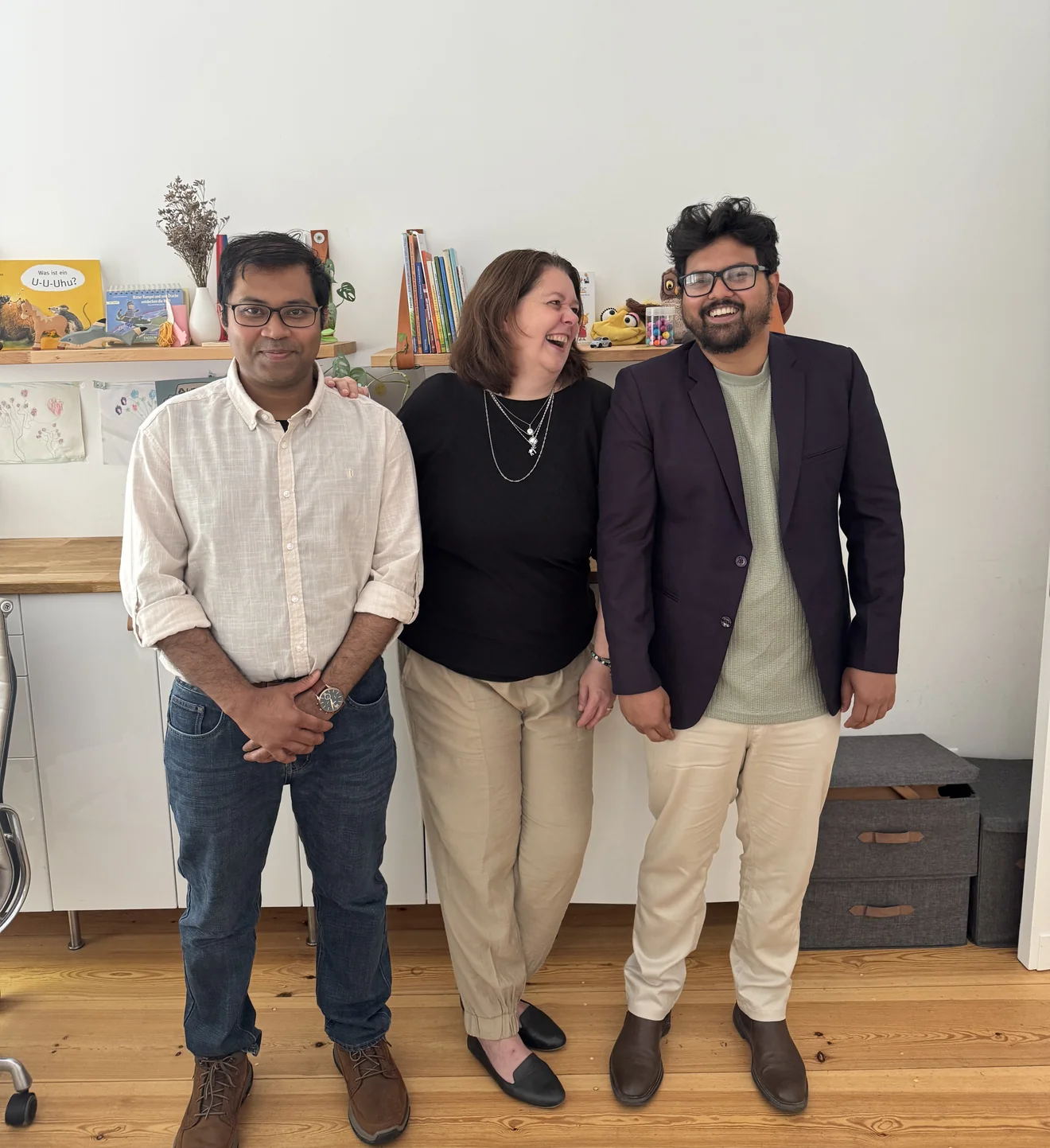
Not a team that has speech therapy explained to it.
A team that knows it from the inside.
Get to know us
Let's talk for 30 minutes.
Not a sales call.
We want to understand how your practice handles home practice today. If Bakbakum is not a fit, we will say so in the same conversation — we would rather do that than start a pilot that quietly dies after four weeks.
What happens in that half hour
You talk
How do things go between two appointments today? What comes back to you from home — and what does not?
We show
The care-plan editor, live. No video, no slides. You see exactly what you would be working with.
You tell us what is missing
The most useful part. Almost every change of the last few months came out of a conversation like this.
Good to know
- 30 minutes, by video
- You speak to one of the founders
- The call is in English
- No child, no patient data in the call
See available times
The calendar comes from Microsoft Bookings. It only connects to Microsoft once you click.